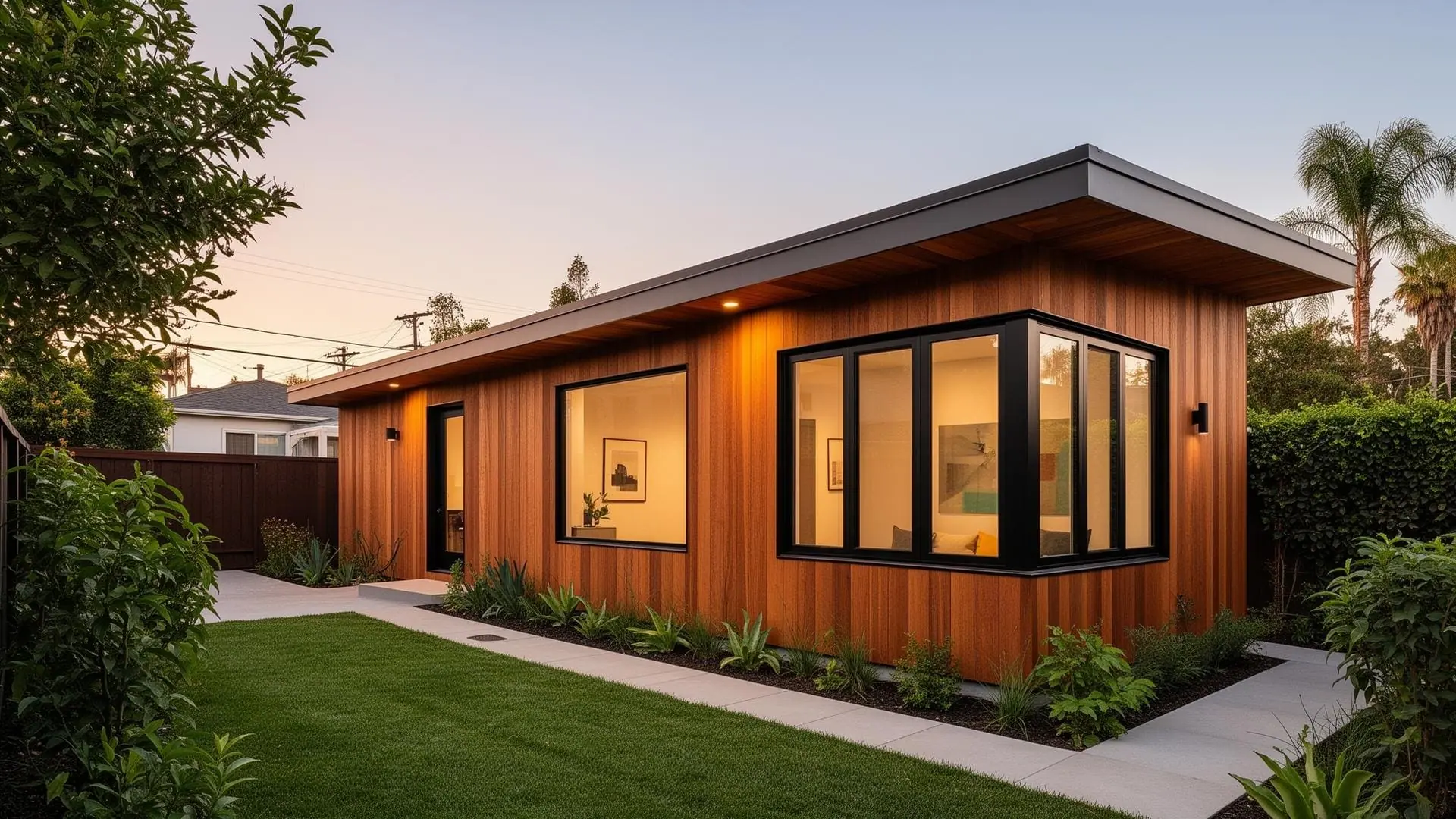
Living in the ADU while the house is rebuilt
State law normally ties an ADU's certificate of occupancy to the primary home. Governor Newsom's Executive Order N-9-25, issued January 16, 2025, suspended that rule for properties substantially damaged or destroyed in the Eaton or Palisades fires, and LA County Planning reported in 2025 that the suspension runs until January 16, 2028 unless ended earlier. The county's interim ordinance allows a household to live in a standalone ADU on a fire lot while it waits for the main home, until January 7, 2030.
A standalone ADU is a permanent building, not temporary housing, so it does not have to be removed later. It must meet current zoning, state ADU law and the Building, Fire, and Health and Safety codes, and the county says it expedites these applications. When the main house is designed, the ADU simply appears on the site plan. Owner-occupants who qualify for the county's rebuild fee deferral can include a standalone ADU they will live in temporarily.
Sizes and types on a single-family lot
Under the county ADU ordinance amendment that took effect August 28, 2025, a single-family lot may have one junior ADU, one attached ADU and one detached ADU. Attached ADUs are capped at 1,200 square feet, and the county's recovery guide lists 1,200 square feet for a newly built detached ADU. A smaller detached unit of up to 800 square feet with 4 foot side and rear setbacks falls under the state's exemption categories, which the county must approve without its local standards.
A junior ADU is limited to 500 square feet and sits entirely inside the main house, existing or proposed, so on a fire lot it is built with the rebuild rather than ahead of it. For height, the county allows ADUs up to 25 feet unless a community standards district sets a lower limit, and state law still guarantees between 16 and 20 feet depending on the project. An ADU of 800 square feet or less may encroach into the front yard setback if there is no other ground-level spot for it.
Fire zone rules that apply to ADUs
If your lot is in a Very High Fire Hazard Severity Zone, the type of ADU matters. Since the 2025 amendment, state-exempt ADUs and junior ADUs are allowed in those zones regardless of vehicular access, while larger ADUs built under the county's local standards generally still have to meet its access requirements. In a Very High zone, an ADU also needs one off-street parking space unless it meets an exemption, such as being within a half mile walk of public transit.
The Eaton Fire interim ordinance adds one parking break: when a new ADU fully or partially overlaps the footprint of a burned garage or covered parking structure, no replacement parking is required. Every new ADU needs fire sprinklers, and on a lot in a fire hazard severity zone it is built with the same fire-resistant construction as the main house. We check the current fire hazard map and access conditions for your parcel before choosing the ADU type.
Septic, water and the utility plan
An ADU adds bedrooms and wastewater, which is where many Altadena plans hit a constraint. The county says an existing septic system must be able to handle the added bedrooms, or be expanded or replaced, and an area for a future dispersal field has to be tested and set aside. Existing cesspools can stay only if flow does not increase, so adding an ADU on a cesspool means upgrading to septic or, within 200 feet of a public sewer, connecting to it.
Water service needs the same forethought. Some Altadena water agencies may require a separate service line and meter for an ADU, and the owner pays the construction cost. We size the septic or sewer connection, water service and electrical service for both buildings from the start, so building the ADU first does not force rework when the main house arrives.
Timing the ADU with the main house
There are two common sequences. In the first, the ADU is permitted and built first, the family moves in, and the main house follows. In the second, the ADU is part of the main rebuild application; the county's definitions allow a like-for-like rebuild project to include a new ADU or junior ADU, as long as those units meet current rules. The 2025 ADU amendment also lets the county defer its ADU decision when the unit is proposed together with new construction.
Building first takes careful site planning. The ADU has to sit outside the future house footprint, the septic dispersal area and the paths that trucks and equipment will need later, and the household living there needs safe access while the main house is under construction. We draw both buildings on one site plan at the outset, even if only the ADU is submitted first.
Renting the unit later
Many owners rent the ADU once the main house is finished. In unincorporated LA County, ADUs and junior ADUs cannot be used as short-term rentals, and rentals of less than 30 days are not allowed. County Planning describes current rules as requiring owner occupancy for a junior ADU that shares a bathroom with the main house, but not for an ADU. Check with the county and your own advisors before you plan around rental income.